Turning Creative Talent Into a Sustainable Business Journey
Article by Dean Burgess
This article is just one of the many informative pieces of content you can find in our Articles section.

Image courtesy of Pexels
Freelance designers, illustrators, writers, photographers, and other creative professionals often pour years into building artistic careers, then hit the same wall: great work doesn’t always translate into steady income. The challenges of creative entrepreneurship show up as fast, unpredictable projects, blurred boundaries with clients, and the pressure to stay inspired while also staying solvent. Yet the opportunities in creative industries are real for those willing to treat their craft and their business with equal care. Sustainable creative businesses are built when creativity is supported by clear decisions and consistent priorities.
Understanding Creativity Plus Business Strategy
A sustainable creative career rests on a simple principle: protect your creative energy while building repeatable business habits that support it. The creative mindset is about making your work distinctive, and the business mindset is about making your income predictable.
Balancing the two takes a light, clear strategy, not a complicated system. The idea behind blending creativity without blending into the noise is that originality attracts attention, but attention fades without follow-through. A plan helps you choose what to make, how to price it, and how to sell it without burning out.
Think of it like packing for a long trip. Inspiration is your fuel, but routines are your map, your supplies, and your spare tire. With both, you can handle slow weeks without panicking or undercharging. That same clarity shows up in how you package and send work to clients.
Package Client Files Once and Stop Chasing Attachments
Strong creative strategy gets even easier to execute when your paperwork and deliverables don’t create friction. Effective document management helps creative professionals stay organized, streamline client work, and keep track of contracts and project details without constant digging through emails or scattered folders. Saving key files as PDFs can make this simpler: PDFs preserve formatting, are easy to share consistently across devices, and create a stable record of what was agreed to and what was delivered.
When you have several related items, like a contract, scope notes, and final deliverables, bundling them into one clean packet reduces back-and-forth and keeps everyone aligned. If you want to combine similar documents, tools to merge multiple PDFs can help you turn a pile of attachments into a single file that’s easier to send, store, and reference.
Define → Offer → Attract → Refine
This rhythm turns big, fuzzy business goals into steady creative business growth stages you can repeat. It keeps audience definition, product and service development, and marketing for creative professionals connected, so you are not improvising every time you need clients.
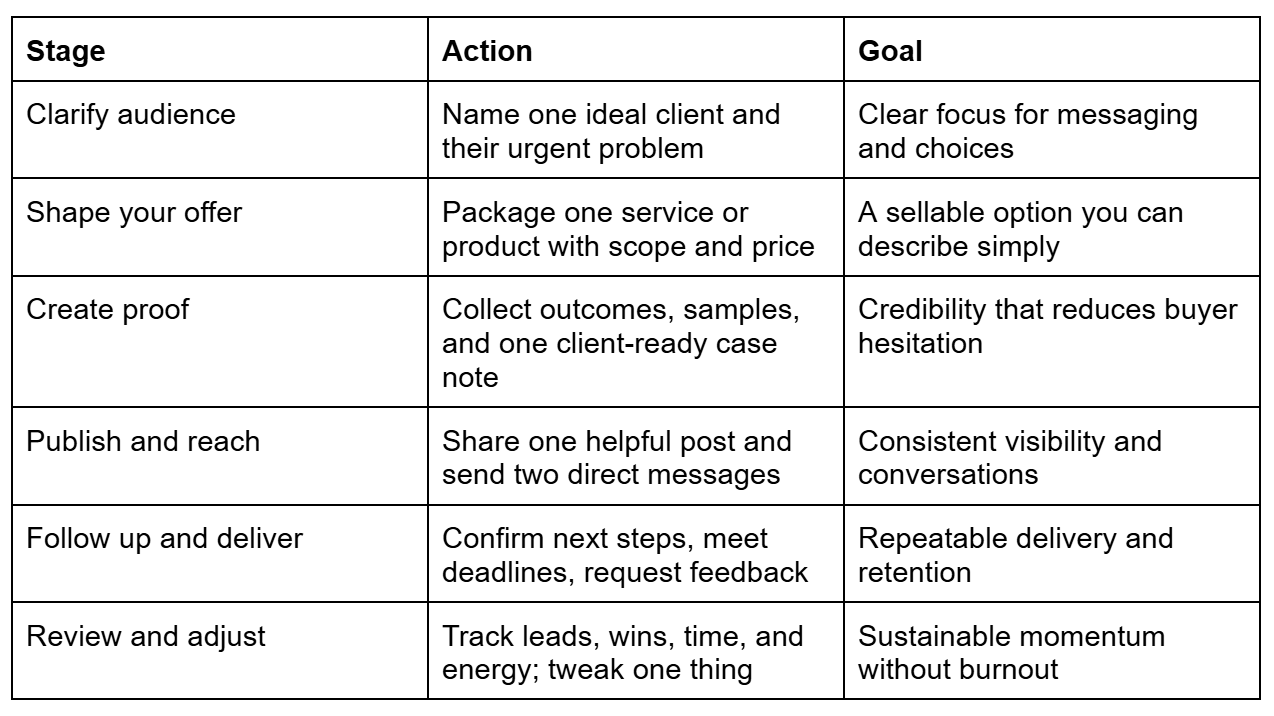
Each stage feeds the next: focus sharpens your offer, proof makes outreach easier, and delivery creates more proof. The review step keeps the whole system aligned with your capacity and the market.
Common Questions Creative Entrepreneurs Ask
Q: How do I find clients without feeling salesy?
A: Lead with help, not hype: share one practical tip, then invite a low-pressure conversation. Keep outreach specific by naming the problem you solve and who it is for. Send a short note to two people you can genuinely support this week.
Q: What should I do if my income is inconsistent month to month?
A: Stabilize with a simple baseline offer you can deliver repeatedly, plus one add-on for higher value. Set a minimum weekly lead goal and track it like a bill you pay. Small, steady activity often smooths out the spikes over time.
Q: How can I raise my prices if I feel inexperienced?
A: Price the outcome and the scope, not your feelings. Add boundaries that protect delivery quality, then collect proof from each project like testimonials, before-and-after samples, and clear results.
Q: What helps when my creative business hits a wall?
A: Build flexibility into your decisions, since strong operators pivot when necessary as conditions change. Pick one bottleneck to fix, such as unclear scope or weak follow-up, and test one adjustment for two weeks.
Q: Can I stay true to my art and still grow commercially?
A: Yes, because artistic integrity can be a business advantage, not a limitation. Define what you will not compromise, then design offers that attract clients who value that point of view.
Turn Creative Talent Into Sustainable Business Momentum This Week
It’s easy to feel pulled between making great work and keeping the business side steady, especially when client flow and confidence wobble. The way forward is a calm blend of creative talent and business strategy, guided by entrepreneurial optimism and a focus on simple, repeatable decisions. Put into practice, this approach starts motivating creative entrepreneurs to take clearer, less stressful actionable steps for business growth, and it shows that consistency is what builds long-term success in creative industries. Sustainable success comes from small decisions repeated, not big bursts of effort.